

UHP in the agent protocol ecosystem
This page is informative, not part of the UHP specification. The protocols below connect different parts of an agent system; the picture illustrates their roles, not a required architecture or a guarantee that every implementation interoperates.
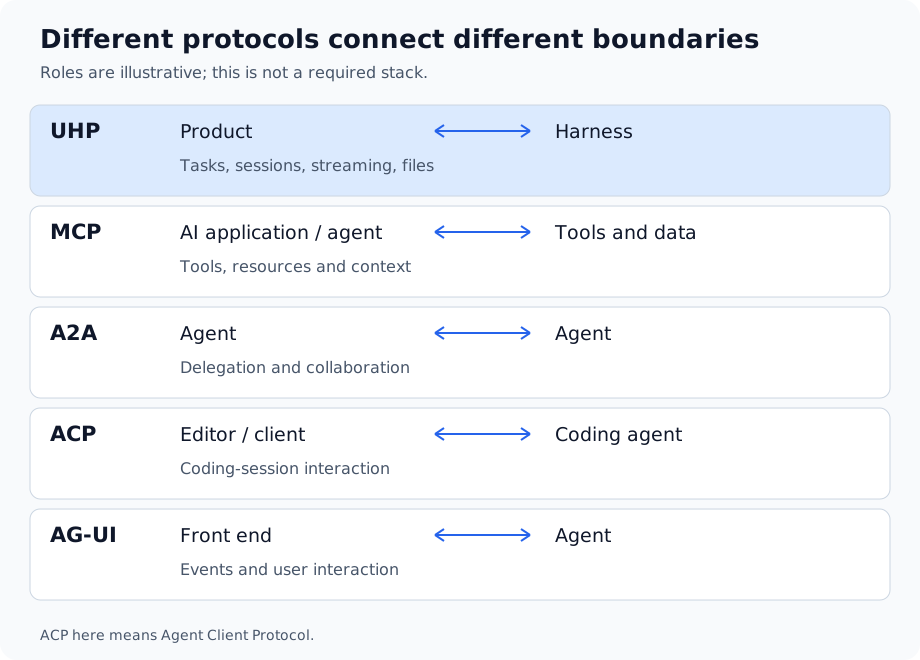
What each protocol connects
MCP (Model Context Protocol) connects an AI application or agent to tools, data and other context exposed by servers. It describes what an agent can access or call, rather than the whole task a product asks a harness to run.
A2A (Agent2Agent Protocol) connects agents so they can discover capabilities, delegate work and exchange results. Its boundary is collaboration between agents, rather than a product choosing and driving a harness.
ACP (Agent Client Protocol) connects an editor or other client to a coding agent, including the interaction around a coding session. Here ACP means Agent Client Protocol, not the unrelated Agent Communication Protocol.
AG-UI (Agent User Interaction Protocol) connects an agent to a front end through events used to present its work and support user interaction. It describes that interaction boundary, rather than how a server runs interchangeable harnesses.
UHP (Unified Harness Protocol) connects a product to a complete agent harness running a task. Its contract covers tasks, sessions, streaming, files and the results a client retrieves, while the harness owns its agent loop and tools.
How they can combine
A product can submit a task through UHP to a server whose harness calls MCP tools: UHP's Plugins chapter describes how plugins carry MCP servers for the harness. An ACP adapter can also sit behind the UHP boundary; this repository's ZeroClaw driver starts the harness's own ACP server over standard input/output. A front end can use AG-UI events around an agent, and agents can collaborate through A2A, where those components support them. These are possible combinations, not features UHP requires every server to implement.